




How AI Rock Mapping Cuts Rock Picking Costs Per Acre
Our sales team hears one question more than any other about rocks: “You say I’ll save $20 an acre. Where does that number come from?”
It’s a fair question. So here’s the full math, the same math that runs inside our Rock Picking Savings Calculator. You’ll see what has to be true to get to $20 an acre, where the savings are big, and where they’re small. Then you can plug in your own crew, your own equipment, and your own rocks.
Key takeaways
- Rock picking cost per acre depends on three things: how many rocks you pick per acre, what your crew costs per hour, and what your equipment costs per hour.
- A TerraClear Rock Map saves money two ways: your crew spends fewer hours in the field, and you get more rocks out of the field for the same work.
- The $20 an acre figure comes from a high-density field, about 8 rocks per acre, with a two-person crew at $20/hr and $20/hr in equipment. It already subtracts the $3.95/ac map list price.
- Savings grow with rock density. In lightly rocky fields, savings are much smaller, and most of the value comes from the rocks you would have missed
What does rock picking cost per acre?
For a crew picking by eye, rock picking costs about $2 to $11 an acre per pass, depending mostly on how rocky the field is. A field with 3 rocks per acre runs about $4.20 an acre. A field with 8 rocks per acre runs about $9.20 an acre.
Those figures come from a simple model of how a crew works a field without a map. The crew drives the field looking for rocks, then stops to pick each one it sees. Our calculator uses these assumptions:
- The crew covers about 50 acres per hour while searching.
- Each rock takes about 1 minute to stop and pick.
- Crew cost per hour = number of people x hourly wage, plus equipment cost per hour (UTV, rock picker, and anything else running).
A two-person crew at $20/hr each, plus $20/hr in equipment, costs $60 for every hour in the field. That $20 wage is close to what the USDA reported for hired field workers in spring 2025: $21.23/hr in the Northern Plains and $19.88/hr in Minnesota, Wisconsin, and Michigan (USDA NASS Farm Labor, May 2025). For comparison, North Dakota’s custom rate survey put rock picking at $68.71/hr in 2020, with equipment, fuel, and operator included (NDSU and USDA NASS, North Dakota Custom Rates).
Field size doesn’t change the per-acre answer in this model. Hours and costs scale with acres, so a 160-acre quarter and a 3,000-acre farm with the same rock density land on the same cost per acre.
Where does the $20 an acre savings come from?
The savings come from two places. Our team calls them the two pillars of value.
- Labor and equipment hours saved. With a map, the crew stops gridding the field and drives from rock to rock. At high rock density, crews work about three to five times faster.
- The value of rocks you would have missed. A TerraClear Rock Map finds about 3x more rocks than a crew finds by eye. Each of those rocks has a value, and the calculator sets it at what you already pay to pick one rock today. At 8 rocks per acre, that’s about $1.15 a rock.
The whole point of picking is to clear the rock. Picking faster is half of it. Getting the rocks out that you’ve been driving past is the other half.
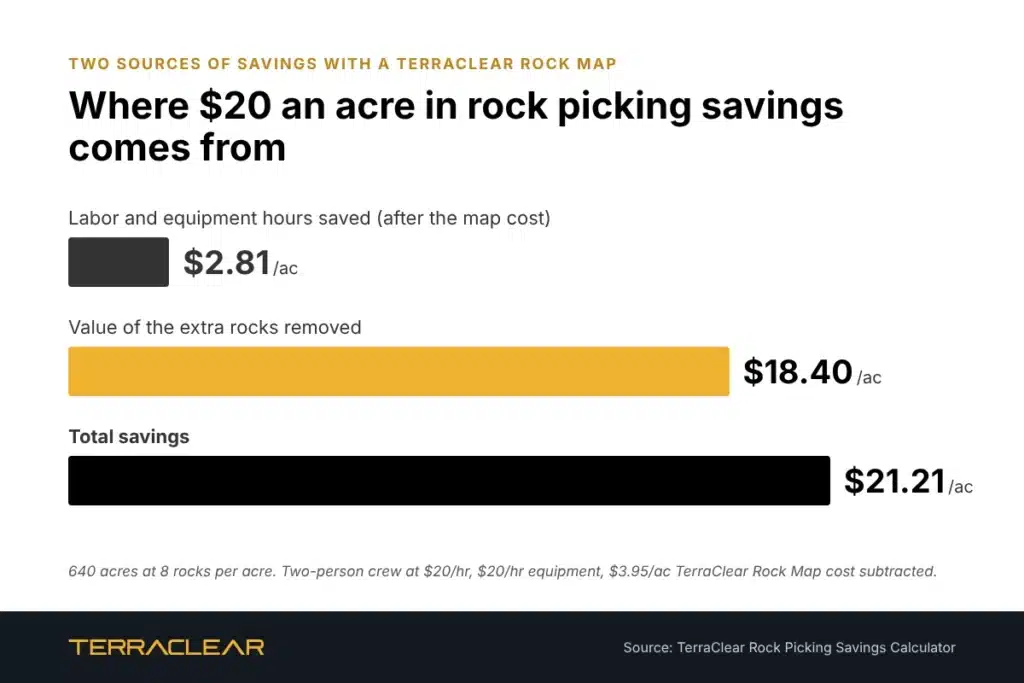
Here’s how those two pillars stack up in the $20 example:
| Savings source | 640-acre field | Per acre |
|---|---|---|
| Crew and equipment hours saved (after paying for the map) | $1,801 | $2.81 |
| Value of the extra rocks removed | $11,776 | $18.40 |
| Total savings | $13,577 | $21.21 |
We round $21.21 down and call it $20 an acre.
How does the $20 an acre math work, step by step?
Here’s every step for one 640-acre section with 8 rocks per acre. The crew is two people at $20/hr, equipment runs $20/hr, and the TerraClear Rock Map is at its $3.95/ac list price.
Step 1: Hours without a map.
- Searching: 640 acres / 50 acres per hour = 12.8 hours
- Picking: 8 rocks x 640 acres = 5,120 rocks. At 1 minute each, that’s 85.3 hours.
- Total: 98.1 hours in the field
Step 2: Cost without a map.
- Crew and equipment: (2 x $20) + $20 = $60 per hour
- 98.1 hours x $60 = $5,888, or $9.20 an acre
- Cost per rock picked: $5,888 / 5,120 rocks = $1.15
Step 3: Cost with a map.
- At 8 rocks per acre, the calculator assumes mapped picking runs about 3.8x faster (10x at 1 rock/ac, tapering to 2x at 10 rocks/ac).
- 98.1 hours / 3.8 = 26 hours in the field, which costs $1,559
- Rock Map: 640 acres x $3.95 = $2,528
- Total with a map: $4,087
Step 4: Hours saved, in dollars.
- $5,888 – $4,087 = $1,801 saved, or $2.81 an acre, after the map is paid for
Step 5: Value of the extra rocks.
- The map shows about 3x the rocks: 15,360 instead of 5,120, so 10,240 more rocks come out of the field
- 10,240 rocks x $1.15 per rock = $11,776, or $18.40 an acre
Step 6: Total.
- $1,801 + $11,776 = $13,577 on 640 acres
- $13,577 / 640 = $21.21 an acre
The calculator counts one picking pass per season. It leaves out equipment damage, downtime, and repairs avoided. Fuel belongs on that list too. Those costs are real, so this math leans conservative.
How does rock density change your savings?
Rock density is the biggest factor. The more rocks you pick per acre today, the more a map saves. Here’s the same crew and equipment ($20/hr wage, two people, $20/hr equipment, $3.95/ac map) across the density range:
| Rocks you pick per acre today | Hours saved, after map cost ($/ac) | Value of extra rocks ($/ac) | Total savings ($/ac) |
|---|---|---|---|
| 1 | -$1.97 | $4.40 | $2.43 |
| 2 | -$1.10 | $6.40 | $5.30 |
| 3 | -$0.26 | $8.40 | $8.14 |
| 4 | $0.54 | $10.40 | $10.94 |
| 5 | $1.29 | $12.40 | $13.69 |
| 6 | $1.95 | $14.40 | $16.35 |
| 7 | $2.49 | $16.40 | $18.89 |
| 8 | $2.81 | $18.40 | $21.21 |
| 9 | $2.72 | $20.40 | $23.12 |
| 10 | $1.65 | $22.40 | $24.05 |
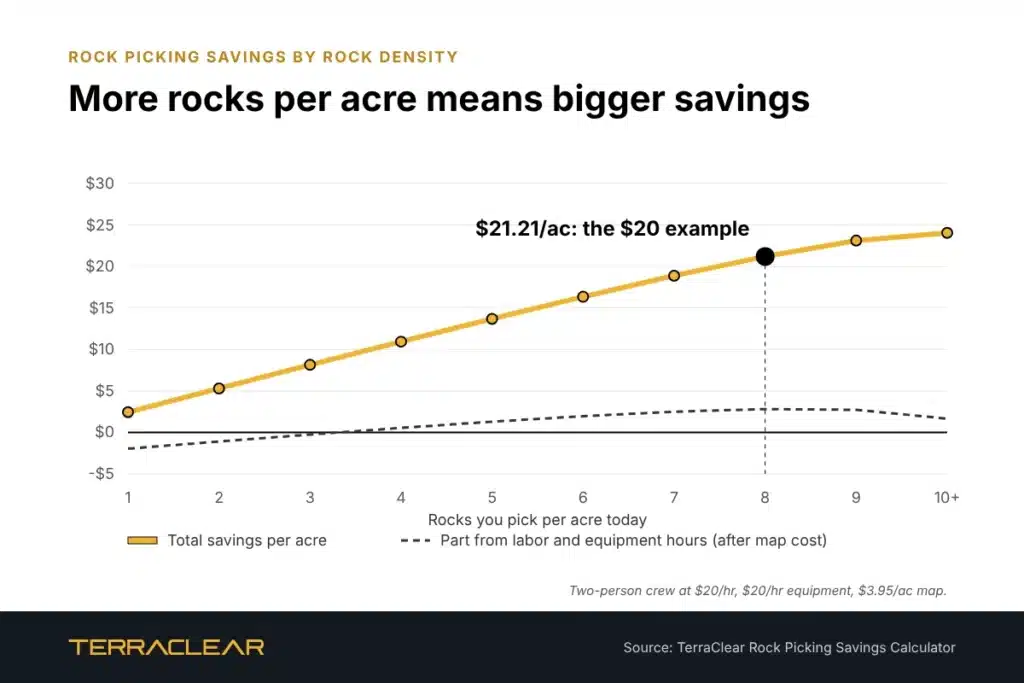
Two things stand out. Under about 4 rocks per acre, the hours you save don’t fully cover the map at list price. In those fields, the case for a map rests on the rocks you’d otherwise leave behind. And from 4 rocks per acre up, both pillars pay, which is where the $20 figure lives.
If you’re not sure how rocky your fields are, your best guess is fine for the calculator. Once a field is mapped, you’ll have a real rock count to work from.
Run your own numbers: Rock Picking Savings Calculator
Set your field size and rock density, then enter your crew size, wage, and equipment cost. Toggle the map on and off to compare picking by eye with driving straight to every mapped rock.
See your rock-picking savings
Set your field size and how rocky it is, then adjust your crew costs. Toggle the map to compare gridding the field by eye with driving straight to every mapped rock.
Your Rock Map
Estimated savings
How this is calculated (assumptions)
- Crew cost per field hour = crew size × hourly wage + equipment depreciation.
- Without a map, the crew drives the whole field to find rocks at about 50 acres per hour, plus about 1 minute to stop and pick each rock it finds.
- A TerraClear Rock Map reveals about 3× more rocks than the crew finds by eye, and the crew drives directly from rock to rock instead of gridding the field.
- Even while picking 3× the rocks, mapped picking is about 10× faster in low-density fields (1 rock/ac), tapering to about 2× faster in high-density fields (10+ rocks/ac), where more of the time goes to picking rather than searching.
- Savings = crew & equipment time saved + the value of the extra rocks picked. Each extra rock is valued at today’s cost per rock picked without a map (crew + equipment cost ÷ rocks picked), i.e. what it would cost your crew to remove it the way you do now.
- Figures are for one picking pass per season. Not included: the equipment damage, downtime, and repairs avoided by removing the rocks a visual scout misses.
What is one rock worth?
About a dollar, and usually pretty close to that. That’s how our team sets the implied value of a rock: what you already spend in crew time and equipment to get one rock off the field. In our example it’s $1.15.
That’s the floor. A rock you never picked can cost far more than a dollar when it meets a header, a planter row unit, or a tillage tool. Machinery costs have climbed fast. University of Illinois farm management data shows repair costs on Illinois grain farms rising from $32 to $39 an acre between 2021 and 2024 (farmdoc daily, October 2025).
Growers who’ve used a TerraClear Rock Map say the same thing about the rocks they had been missing:

“When I first heard of this technology, I did not think it would be useful. Now that I have used it, you realize how many rocks you have been driving by. … If this saves you from hitting a rock with a chopping corn head, it has paid for itself.”
David Holte, David Holte Farms
“One of the biggest eye-openers with TerraClear rock mapping was seeing the rocks it found during post-plant flights in fields we had already picked by driving every pass. … That saves time, reduces equipment damage, and gives us peace of mind knowing the major damaging rocks are out of the field.”
Travis Voit, Sauk Centre, Minnesota

What does this look like on a real farm?
Jacob Ebeling farms more than 4,000 acres of corn and soybeans near Trimont, Minnesota. His family once ran a rock picking crew of 16. As labor got harder to find, that crew kept shrinking.

“We just didn’t have the available labor to get the job done anymore. The Rock Map made it possible to remove every rock we needed to get with fewer people.”
Jacob Ebeling, Ebeling Family Farms
With TerraClear Rock Maps and a suggested pick route for each field, Jacob’s crew went from 9 people to 1. Two weeks of work got done in one. The Ebeling’s saved 640 labor hours, worth $7,680 in labor (TerraClear case study, 2022)
What if you hire someone to pick your rocks?
The math works the same way. TerraClear doesn’t pick rocks, but we can refer you to independent rock picking operators. If you hire one, enter their hourly rate in the calculator as a one-person crew, with equipment at $0 since it’s built into the rate. North Dakota’s last published average was $68.71/hr (2020).
At that rate and 8 rocks per acre, the calculator shows about $25 an acre in savings. A map also gives the operator a real rock count to quote against, so you aren’t paying for hours spent hunting.
How do you get the most out of a TerraClear Rock Map?
A few habits make the savings above more likely to show up on your farm:
- Map the whole field. TerraClear maps every acre, not a sample, so the rock count is the real count for that field.
- Pick from the map, not from memory. Each rock has a GPS-pinpointed location, and the app builds a suggested pick route. Matthew Pueppke of Erie, North Dakota, put it this way: “Instead of guessing or making multiple passes, I could watch the process unfold in real time and understand exactly what needed to be picked.”
- Choose the rocks that matter. Maps show rocks 8″ and larger, and you can filter by size before you head out.
- Get the map in time to use it. Maps arrive the next day on average once the field is flown.
- Use the right GPS. Your phone, a receiver, or RTK will all get you to the rock. Our guide to GPS for rock picking covers how close each one gets you.
Planning your next season? See what fall rock mapping can and can’t do, how to order Rock Maps for 2027, and our winter farm planning guide. You’ll find the calculator on our rock management page too.
Want to check the math on your own fields?
Every field is different. That’s why we’d rather walk through your numbers than quote you ours. Talk to a TerraClear rep and we’ll run the calculator with your rock density, crew, and equipment costs, or call (712) 545-7144.
Frequently Asked Questions
All prices are market dependent. From TerraClear’s experience, for a crew picking by eye, about $2 to $11 an acre per pass, depending on rock density. A two-person crew at $20/hr with $20/hr in equipment runs about $4.20 an acre at 3 rocks per acre and $9.20 an acre at 8 rocks per acre. Your crew cost and rock density move the number the most.
No. It’s an example from a high-density field, about 8 rocks per acre, with a two-person crew at $20/hr and $20/hr in equipment. Fields with fewer rocks save less. Run your own numbers in the Rock Picking Savings Calculator.
Yes. The calculator subtracts the map cost, $3.95 an acre at list price, before it reports savings. You can change the map price in the calculator if your quote is different.
Clearing rocks is the reason you pick. A TerraClear Rock Map finds about 3x more rocks than a crew finds by eye. The calculator values each extra rock at what you already pay to pick one rock today, usually about $1. It doesn’t count equipment damage those rocks would have caused.
In the calculator, the range runs from 1 rock per acre (low) to 10 or more (high). The $20 an acre example uses 8 rocks per acre. Savings start to come from both labor and extra rocks at about 4 rocks per acre.
Not in the calculator. Hours and costs scale with acres, so your total savings grow with field size, but savings per acre stay the same at a given rock density, crew cost, and equipment cost.
No. TerraClear makes the Rock Map. You pick the rocks with your own crew and equipment, or we can refer you to an independent rock picking operator.
Connect with TerraClear
Sources
- TerraClear Rock Picking Savings Calculator, terraclear.com/solutions/rock-management/
- USDA NASS, Farm Labor report, May 21, 2025: esmis.nal.usda.gov
- NDSU Extension and USDA NASS, 2024 North Dakota Custom Rates Part II: ndsu.edu
- Schnitkey, Paulson, Zulauf, and Zwilling, “Large Increase in Machinery Costs Suggests Need to Reconsider Machinery Purchase Decisions,” farmdoc daily, Oct. 14, 2025: farmdocdaily.illinois.edu
- TerraClear, Rock Map Use Case Study: Ebeling Family Farms, 2022

Josh Ring is Inside Sales Director at TerraClear, where he leads the team that helps farmers put TerraClear Rock Maps and Weed Maps to work on their operations. He joined TerraClear in 2025 after nearly eight years at Farmers Business Network, where he built and led sales development, sales enablement, and sales operations teams. Josh is based in Sioux Falls and studied media and journalism at the University of South Dakota.