


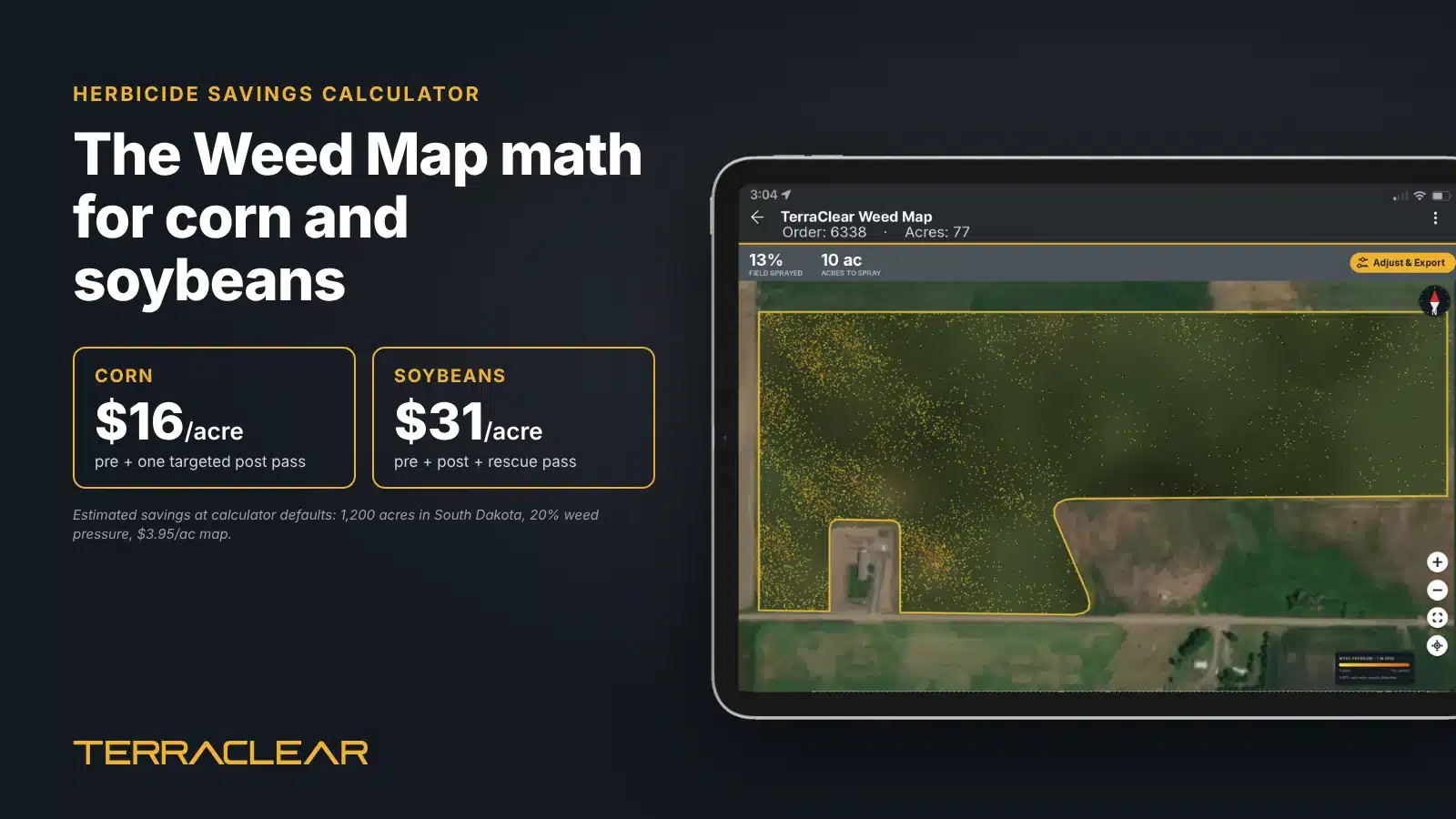
Herbicide Savings Calculator: The Weed Map Math for Corn and Soybeans
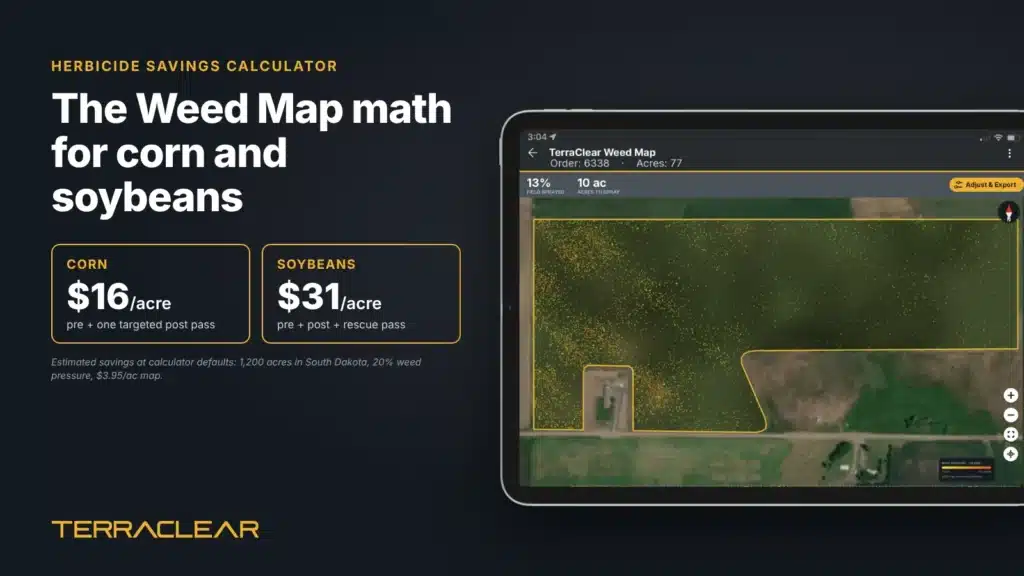
Our sales team hears the same question about weeds that it hears about rocks: “Your calculator says I’ll save $16 an acre on corn and $31 on soybeans. Where do those numbers come from?”
Fair question. Here’s the math that runs inside our herbicide savings calculator, one pass at a time, for both crops. You’ll see why corn and soybeans land in different places, which settings move the number most, and where the savings shrink. Then you can run it with your own costs.
Key takeaways
- The calculator compares two programs on the same field: a broadcast program, and the same program with the post-emerge passes sprayed from a TerraClear Weed Map precision plan.
- Only the post-emerge passes change. Your pre-emerge residual and your application cost stay the same, so they cancel out.
- The savings formula for each targeted pass is simple: post-pass product cost x share of the field you don’t spray, minus the map price.
- Corn with a pre and one post pass: an estimated $16.05 an acre, or $19,260 on 1,200 acres in South Dakota at 20% weed pressure.
- Soybeans with a pre, a post, and a rescue pass: an estimated $31.20 an acre, or $37,440 on the same 1,200 acres.
- Both default programs line up with Iowa State’s 2026 herbicide budgets. Weed pressure moves the number most.
What does the herbicide savings calculator estimate?
It estimates how much you’d spend on herbicide and application in one season with a broadcast program, how much you’d spend if the post-emerge passes were targeted with a TerraClear Weed Map, and the difference. It reports that difference per acre and for the whole field, along with how much less post-pass product goes out.
You set six things:
- Field size
- Crop (corn or soybeans) and state, which set default product costs
- Weed pressure, the share of the field with weeds at post time
- Whether you run a third, rescue pass for escapes, and how much of the field it covers
- Your product and application costs per acre
- The map price per acre ($3.95 MSRP)
Defaults come from land-grant extension weed guides and typical custom rates, adjusted by state. They’re a starting point. Your invoices are better.
Why do corn and soybeans save different amounts?
It comes down to how many passes get targeted. Most corn programs are a pre and one post. Soybean programs often add a second post pass for late waterhemp, and every targeted pass adds savings. Per pass, corn saves a little more, because its post-pass product costs more.
Both examples below use the calculator’s South Dakota defaults on 1,200 acres, 20% weed pressure, $8/ac application per pass, and the map at $3.95/ac. The programs line up with Iowa State’s 2026 crop budgets, which put herbicide at $56 an acre for corn and $75 an acre for herbicide-tolerant soybeans, with two sprays assumed for beans (Iowa State Ag Decision Maker A1-20).
| Corn | Soybeans | |
|---|---|---|
| Program | Pre + one post | Pre + post + rescue on 10% of field |
| Pre-emerge product | $31/ac | $26/ac |
| Post-emerge product, per pass | $25/ac | $23/ac |
| Total herbicide product, broadcast | $56/ac | $72/ac |
| Iowa State 2026 herbicide budget | $56/ac | $75/ac |
| Estimated savings with a Weed Map | $16.05/ac | $31.20/ac |
| Savings on 1,200 acres | $19,260 | $37,440 |
How much does a TerraClear Weed Map save in corn?
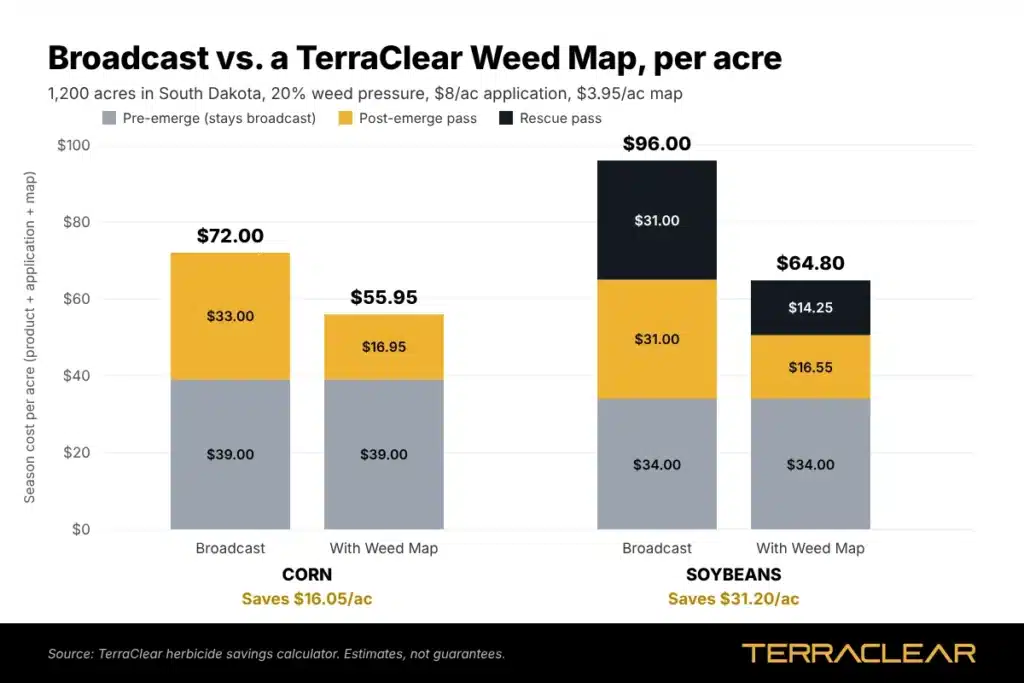
At the calculator’s South Dakota corn defaults, a pre and one targeted post pass save an estimated $16.05 an acre. That’s $19,260 on 1,200 acres.
| Pass | Broadcast ($/ac) | With a TerraClear Weed Map ($/ac) | Difference ($/ac) |
|---|---|---|---|
| Pass 1: pre-emerge residual | $39.00 | $39.00 | $0.00 |
| Pass 2: post-emerge | $33.00 | $16.95 | $16.05 |
| Program total | $72.00 | $55.95 | $16.05 |
Here’s how Pass 2 gets from $33.00 to $16.95:
- Product goes on the 20% of the field with weeds: $25 x 0.20 = $5.00
- Application stays the same, because you still drive the whole field: $8.00
- Map: $3.95
- Total: $16.95/ac
In Iowa, where the corn defaults run $33 pre and $27 post, the same math gives $17.65 an acre.
How much does a TerraClear Weed Map save in soybeans?
At the calculator’s South Dakota soybean defaults, a pre, a targeted post pass, and a targeted rescue pass save an estimated $31.20 an acre. That’s $37,440 on 1,200 acres.
| Pass | Broadcast ($/ac) | With a TerraClear Weed Map ($/ac) | Difference ($/ac) |
|---|---|---|---|
| Pass 1: pre-emerge residual | $34.00 | $34.00 | $0.00 |
| Pass 2: post-emerge | $31.00 | $16.55 | $14.45 |
| Pass 3: rescue for escapes | $31.00 | $14.25 | $16.75 |
| Program total | $96.00 | $64.80 | $31.20 |
Pass 2 works like corn: $23 x 0.20 = $4.60 in product, plus $8.00 application, plus the $3.95 map, for $16.55. Pass 3 treats the 10% of the field with escapes: $2.30 in product, $8.00 application, and a second map, because escapes come up after the first one flies. That’s $14.25.
With the rescue pass on, the calculator’s soybean product cost is $72 an acre in South Dakota and $76 in Iowa, in line with Iowa State’s $75 budget. In Iowa, the soybean estimate is $32.90 an acre.
What’s the formula behind both crops?
Strip out everything that cancels and each targeted pass reduces to one line:
Savings per pass = post-pass product cost x (1 – share of field sprayed) – map price
- Corn, Pass 2: $25 x 0.80 – $3.95 = $16.05
- Soybeans, Pass 2: $23 x 0.80 – $3.95 = $14.45
- Soybeans, Pass 3: $23 x 0.90 – $3.95 = $16.75
Add up the targeted passes and you have the season estimate. That’s the whole model.
Why don’t the pre-emerge pass and application cost change?
A residual has to cover soil where weeds haven’t come up yet, so it goes on broadcast either way. University of Minnesota Extension made the same point reviewing targeted spray research: residuals stay broadcast, and savings come from the foliar pass (UMN Extension, 2025).
Application cost works the same way. Whether the boom is on or off, the sprayer covers every acre, so you pay to run it across every acre. Iowa State’s 2026 survey puts custom self-propelled spraying at $9.35 an acre on average (Iowa State Custom Rate Survey 2026), and the calculator defaults to $8. Change it and the dollar savings don’t move. Only the program totals do.
Don’t cut the residual to chase post-pass savings. A strong pre is what keeps weed pressure low enough for targeting to pay. University of Wisconsin trials found 65% foliar savings in corn behind a strong pre-emergence program and 15% or less behind a weak one or none (Badger Crop Network, 2025).
How does weed pressure change your savings?
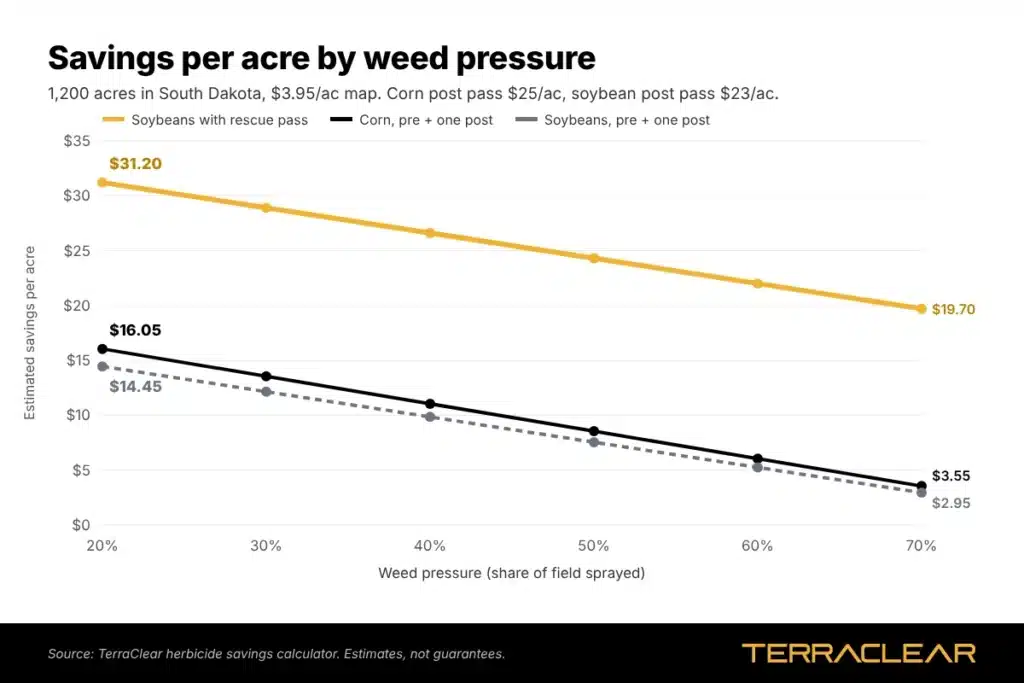
Weed pressure is the biggest lever in the calculator. Every 10 points of pressure takes $2.50 an acre off a $25 corn post pass and $2.30 off a $23 soybean post pass.
Here’s the same 1,200 acres in South Dakota across the slider’s range, with everything else unchanged:
| Weed pressure | Post-pass product cut | Corn, pre + one post ($/ac) | Soybeans, pre + one post ($/ac) | Soybeans with rescue pass ($/ac) |
|---|---|---|---|---|
| 20% | 80% | $16.05 | $14.45 | $31.20 |
| 30% | 70% | $13.55 | $12.15 | $28.90 |
| 40% | 60% | $11.05 | $9.85 | $26.60 |
| 50% | 50% | $8.55 | $7.55 | $24.30 |
| 60% | 40% | $6.05 | $5.25 | $22.00 |
| 70% | 30% | $3.55 | $2.95 | $19.70 |
The slider starts at 20% on purpose. That’s where the post-pass cut reaches 80%, the top of what TerraClear Weed Maps are built to deliver. Light-pressure fields are where up to 80% less herbicide comes from.
A single targeted pass stays positive across the slider, but it gets thin. It breaks even at about 84% of the field sprayed in corn and about 83% in soybeans. Outside research shows the same shape. Wisconsin data reviewed by UMN found 70% to 76% savings on low-pressure soybean fields and about 2% on high-pressure ones (UMN Extension, 2025). Kansas State modeled a 100-acre drone-mapped field and found net savings of $1,860 at 10% weedy, falling to $29 at 90% (K-State Agronomy eUpdate, 2026).
If you don’t know your pressure, run the calculator at 20%, 35%, and 50% and plan around the middle.
When does the rescue pass belong in your math?
Leave the rescue pass on if you’d otherwise broadcast a third pass over the whole field. Turn it off if you wouldn’t. That usually means on for soybeans with late waterhemp and off for corn.
The calculator compares a full broadcast rescue pass with a targeted one that only treats escapes. Waterhemp has a long emergence window that peaks in late June to early July, often after an early residual has run out, according to University of Minnesota Extension. In UMN’s soybean trial, two layered passes held waterhemp control at 90% to 95% through September, compared with 62% to 81% for a single pre-emerge pass. A single waterhemp plant can produce about 250,000 seeds (Take Action, 2026), so escapes cost you again next year.
Three things to know about how the calculator handles it:
- It charges for a second map. Escapes come up after the first flight, so a rescue pass needs a fresh look at the field.
- The escape area defaults to 10%. In soybeans, a rescue pass on 5% of the field saves $17.90 an acre. On 25%, $13.30.
- It assumes the same post-pass product cost. If your rescue mix is cheaper, lower the number and the savings drop with it.
The calculator opens on corn with the rescue pass switched on, which shows $34.60 an acre. That’s the right corn number only if you’d broadcast a third pass over your corn. Most corn programs fit Iowa State’s $56 budget for a pre and one post, so uncheck the rescue pass and you’ll see $16.05.
Run your own numbers: herbicide savings calculator
The calculator opens on corn in South Dakota. For a corn program with a pre and one post, uncheck the rescue pass. For soybeans, pick Soybeans and leave the rescue pass on if you run one. Then enter your own product and application costs and slide weed pressure to see which passes drive your savings.
See your field savings
Adjust the field below to match your operation. Toggle between a conventional broadcast program and TerraClear precision to see the difference on every pass.
Your weed map
Estimated savings
How this is calculated (assumptions)
- Two-pass program: Pass 1 pre-emerge (broadcast, unchanged) + Pass 2 post-emerge.
- Precision converts Pass 2 to targeted spot-spray: post-emerge product applied only to weed-covered acres, plus a TerraClear precision fee/ac.
- Program templates & per-acre chemical + custom-application costs are directional, based on public land-grant extension weed guides (e.g., ISU, U of MN, NDSU) and typical custom-rate pricing. Not a formal recommendation.
- Default weed pressure (~40% of acres) and the patchy weed pattern reflect published John Deere See & Spray green-on-green results, which averaged ~59% herbicide savings in 2024 (range ~35–73%). TerraClear precision fee is a flat per-acre rate ($3.95 USD / CA$5.50).
Where do the calculator’s default costs come from?
Defaults start from a base program for each crop, then shift up or down by state:
| Crop | Base pre-emerge product | Base post-emerge product | Application per pass |
|---|---|---|---|
| Corn | $32/ac | $26/ac | $8/ac |
| Soybeans | $27/ac | $24/ac | $8/ac |
The state adjustment runs from 0.95 in North Dakota to 1.05 in Illinois. South Dakota corn lands at $31 pre and $25 post, and South Dakota soybeans at $26 and $23. In Iowa, corn lands at $33 and $27, and soybeans at $28 and $24. Those base costs are directional, built from extension weed guides (Iowa State, University of Minnesota, and NDSU) and typical custom rates.
For a gut check, compare them with published 2026 budgets:
| Source | Corn herbicide | Soybean herbicide |
|---|---|---|
| Iowa State, 2026 | $56/ac | $75/ac (herbicide-tolerant, two sprays) |
| NDSU, southeast North Dakota, 2026 | $37.50/ac | $46/ac |
| SDSU Extension | $50 to over $100/ac for many programs, corn or soybeans |
Sources: Iowa State A1-20, NDSU EC1659, SDSU Extension, 2025.
If your program costs less, like the North Dakota budgets above, use your numbers. Post-pass cost matters almost as much as weed pressure. At 20% pressure, one targeted pass saves $8.05 an acre on a $15 post pass, $12.05 on a $20 pass, $16.05 on a $25 pass, and $28.05 on a $40 pass. Spray researcher Tom Wolf ran similar math with a $4 per-acre fee and 75% savings, and found the post pass has to cost more than about $5 an acre to break even (Sprayers101, 2026). Most Corn Belt post passes clear that easily.
For full 2026 budget and equipment numbers, see what targeted spraying actually costs.
What does the calculator leave out?
The calculator is built to be simple enough to check by hand. That means it skips a few things that can move your real number either way:
- How your sprayer turns on. The calculator treats weed pressure as the share of the field sprayed. Section control turns on a whole section for one weed, and spray buffers add area around weedy spots. If you run section control, enter a pressure a little higher than what you’d see from the field. Nozzle control sprays tighter.
- Yield. Weeds left uncontrolled cost yield, and spraying a clean crop doesn’t help it. Neither shows up in the dollar figure.
- Less mix left over. A map shows how much of the field needs product before you fill the tank, so you can mix closer to what the field needs. The calculator doesn’t count leftover mix or refill trips.
- Seasonal map pricing. The calculator uses the $3.95/ac MSRP. If you buy at a seasonal price, enter it and savings go up.
- Field size. It doesn’t change savings per acre. Costs scale with acres, so a 160-acre quarter and a 3,000-acre farm at the same settings land on the same per-acre number.
It’s an estimate, not a promise. Your chemistry, pressure, and pricing decide the real answer.
How do you get the most out of a TerraClear Weed Map?
The math above only shows up in the field if the map is good and the plan gets used. A few habits help:
- Map the whole field. TerraClear images every acre at 1.5mm resolution, not samples, and detects weeds down to 1/4″. Small weeds are easier to control, and they’re the ones that grow into next month’s escapes.
- Fly close to the pass. Weeds keep coming, and a map describes the field on the day it flies. Maps arrive the next day on average, so the precision plan is ready while weeds are still small enough for the label.
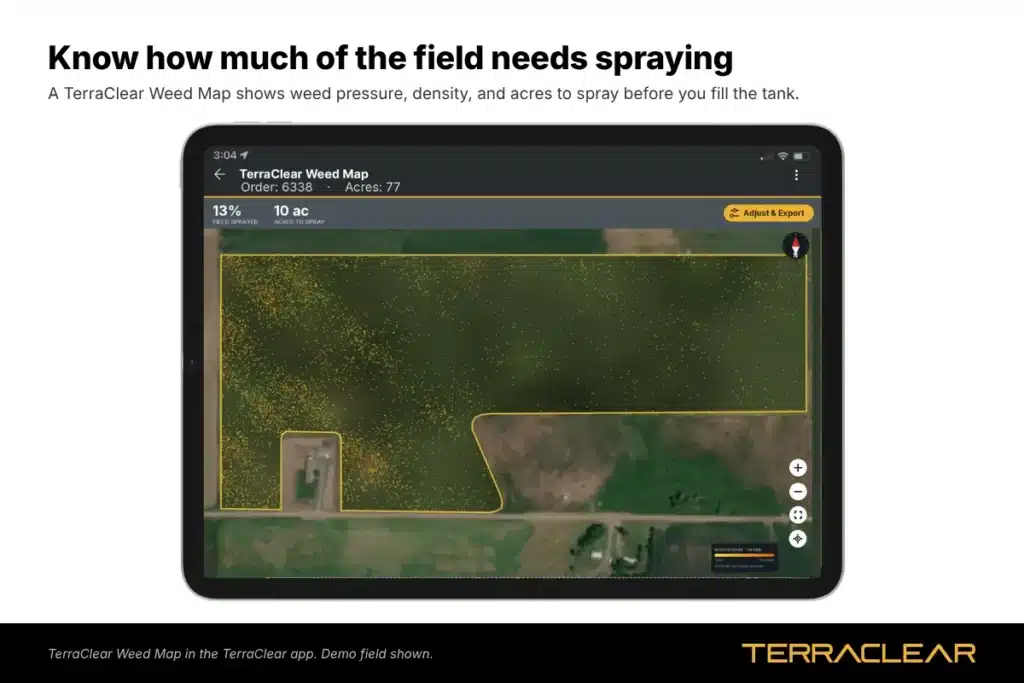
- Plan the tank before you leave the yard. The map shows weed pressure and density by field. Use it with your agronomist to pick products and set quantities, then mix for what the field needs. A camera sprayer can’t tell you that before the pass.
- Use the sprayer you have. The precision plan integrates with most commonly used controllers and monitors. If you run John Deere See & Spray, the plan runs alongside the cameras. More in targeted spraying without a new sprayer.
- Map your corn and soybean fields. That’s where TerraClear Weed Maps work today. Stand counts come with every map.
Isaak Brown, of Brown Harvesting in Devils Lake, North Dakota, put it plainly: “The thing I like about the Weed Map is that every farmer has weeds. People can’t successfully farm without taking care of their weeds.”
For the 2027 growing season, TerraClear Weed Maps have an MSRP of $3.95 per acre mapped, with seasonal pricing incentives. Check current pricing or open the TerraClear Mobile App for the latest rate.
Planning next season? Read our winter farm planning guide and how to order Rock and Weed Maps for 2027. If you also pick rocks, here’s the math behind our rock picking savings calculator.
Want to check the math on your own fields?
Every field is different. That’s why we’d rather run your numbers than quote you ours. Talk to a TerraClear rep and bring last year’s spray invoices for corn and soybeans, or call (712) 545-7144. We’ll run the calculator with your weed pressure, your post-pass costs, and your programs.
Frequently Asked Questions
It prices a broadcast program and the same program with post-emerge passes targeted by a TerraClear Weed Map, then subtracts. For each targeted pass, savings equal post-pass product cost times the share of the field you don’t spray, minus the map price. Pre-emerge and application costs don’t change.
At the calculator’s South Dakota corn defaults, a pre and one targeted post pass at 20% weed pressure save an estimated $16.05 an acre, or $19,260 on 1,200 acres. Those defaults add up to $56 an acre in herbicide, the same as Iowa State’s 2026 corn budget.
At the calculator’s South Dakota soybean defaults, a pre, a targeted post pass, and a targeted rescue pass at 20% weed pressure save an estimated $31.20 an acre, or $37,440 on 1,200 acres. With one targeted post pass and no rescue pass, the estimate is $14.45 an acre.
Soybean programs often include a second post pass for late weeds like waterhemp, and the calculator targets both. Corn programs usually have one post pass. Per pass, corn saves a little more because its post-pass product costs more.
No. They’re the calculator’s estimates at its default settings. Your weed pressure, chemistry, and pricing decide the real answer. Run your own numbers or talk to a TerraClear rep.
Yes. The calculator subtracts $3.95 an acre (MSRP) for each targeted pass, so a rescue pass counts a second map. You can enter a different map price if yours is lower.
You still drive every acre, so you pay to cover every acre. A map changes how much product goes out, not how much ground the sprayer covers.
Use your scouting notes or last year’s escapes. If you’re not sure, run it at 20%, 35%, and 50%. TerraClear Weed Maps are built to cut post-pass herbicide use by up to 80%, which happens on light-pressure fields where about one acre in five needs spraying.
Only if you’d otherwise broadcast a third pass. It’s common in soybeans with late waterhemp. Most corn programs are a pre and one post, so turn it off for corn.
Connect with TerraClear
Sources
- TerraClear Weed Savings Calculator, terraclear.com/weed-savings/
- Iowa State University Extension, Estimated Costs of Crop Production in Iowa 2026 (A1-20): extension.iastate.edu
- Iowa State University Extension, Iowa Farm Custom Rate Survey 2026 (A3-10): extension.iastate.edu
- NDSU Extension, Projected 2026 Crop Budgets, Southeast North Dakota (EC1659): ndsu.edu
- Jones et al., “Inexpensive and Simple Herbicide Programs in Corn and Soybean Will Not Be Effective,” SDSU Extension, updated July 18, 2025: extension.sdstate.edu
- University of Minnesota Extension, “Targeted Spray Technology Highlighted,” Jan. 21, 2025: blog-crop-news.extension.umn.edu
- University of Minnesota Extension, “Got Waterhemp? Layer Residual Herbicides to Maintain Control”: extension.umn.edu
- University of Wisconsin, Badger Crop Network, Oct. 24, 2025: badgercropnetwork.com
- Kansas State University Agronomy eUpdate, Issue 1109, June 25, 2026: agronomy.k-state.edu
- Tom Wolf, “The Economics of Spot Sprays,” Sprayers101, April 2026: sprayers101.com
- Take Action Waterhemp Factsheet, 2026: growiwm.org

Josh Ring is Inside Sales Director at TerraClear, where he leads the team that helps farmers put TerraClear Rock Maps and Weed Maps to work on their operations. He joined TerraClear in 2025 after nearly eight years at Farmers Business Network, where he built and led sales development, sales enablement, and sales operations teams. Josh is based in Sioux Falls and studied media and journalism at the University of South Dakota.