


Key takeaways
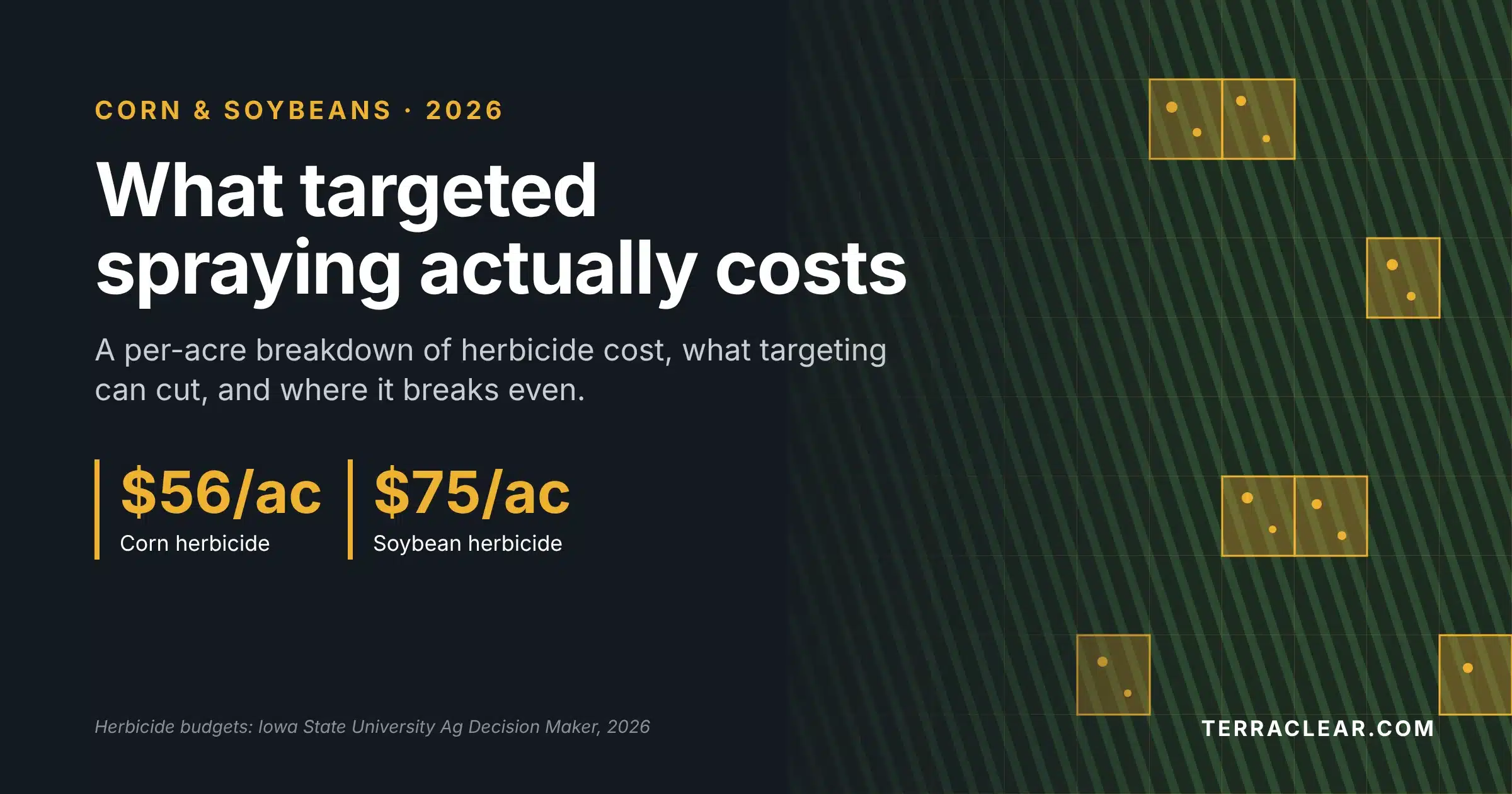
- Iowa State budgets 2026 herbicide at $56 per acre for corn and $75 per acre for herbicide-tolerant soybeans, up $9 and $10 from 2025.
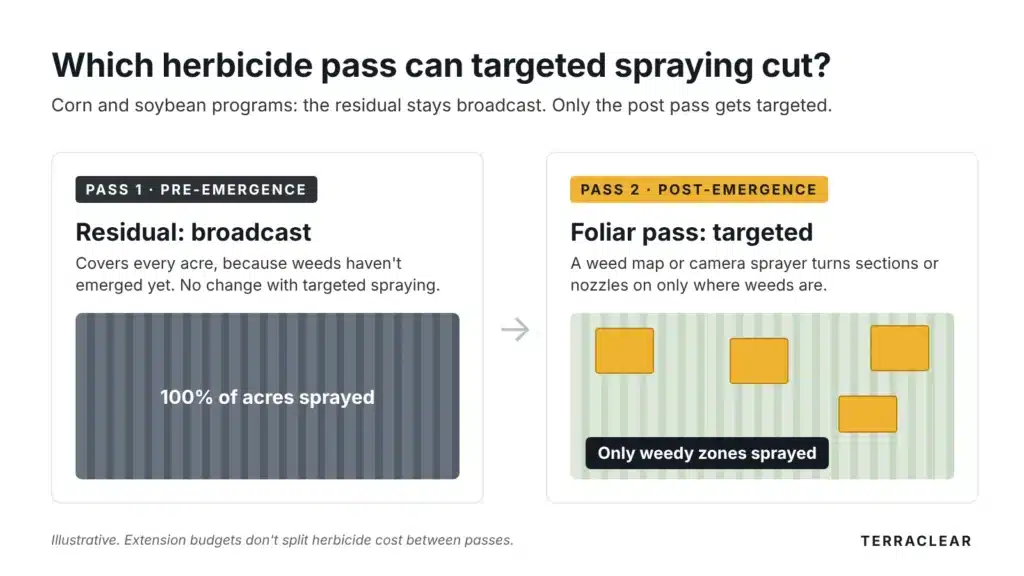
- Targeted spraying only cuts the post-emergence pass. Your residual still goes on broadcast.
- Savings depend on how much of the field you end up spraying. University trials range from about 2% on heavy-pressure fields to about 90% on clean ones.
- On a 1,200-acre field with a $20 post pass, a TerraClear Weed Map at the $3.95 MSRP pays for itself until about four of every five acres need spraying.
- You don’t need a new sprayer. A map works with the section or nozzle control you already run.
- Run your own numbers in the Weed Savings Calculator or talk to a TerraClear rep.
In this article
- How much does herbicide cost per acre in 2026?
- Which part of the bill can targeted spraying cut?
- How much herbicide does targeted spraying save?
- How much does targeted spraying equipment cost?
- What’s the ROI on a 1,200-acre field?
- When is targeted spraying not worth it?
- Will a weed map pencil out on my farm?
- FAQ
Every acre you spray costs the same to cover. The product in the tank is the part you can change. Before you pay for any kind of targeted spraying, it helps to know three numbers: your herbicide cost per acre, how much of it can actually be targeted, and what the targeting costs you. Here’s each one, with the sources behind it.
What is targeted spraying? Targeted spraying, or spot spraying, puts herbicide only where weeds are, not across the whole field. Cameras on the boom find weeds as you drive, or a weed map made before the pass tells your sprayer where to turn on.
A TerraClear Weed Map is a whole-field drone map of a corn or soybean field that shows weeds 1/4″ and larger, with a precision plan your sprayer can run, delivered the next day on average. The precision plan is the field-by-field spray instructions that come with the map, ready to load into your monitor.
How much does herbicide cost per acre for corn and soybeans in 2026?
Iowa State University’s 2026 crop budgets put herbicide at $56 per acre for corn and $75 per acre for herbicide-tolerant soybeans after corn, with two sprays assumed for beans. Custom application adds about $9 to $11 per acre for each pass across the Corn Belt.
Those are planning figures, not quotes. Your retailer’s price and your program decide the real number. They still give you a solid baseline, and they’re climbing. Iowa State had corn at $47 and soybeans at $65 a year earlier.
| Budget line | Corn | Soybeans | Source |
|---|---|---|---|
| Herbicide, Iowa (2026) | $56/ac | $75/ac (herbicide-tolerant, two sprays) | Iowa State Ag Decision Maker A1-20 |
| Herbicide, Iowa (2025) | $47/ac | $65/ac | Iowa State A1-20, 2025 |
| Herbicide, southeast North Dakota (2026) | $37.50/ac | $46/ac | NDSU projected budgets EC1659 |
| Herbicide programs, Indiana (2026) | About $49 to $62/ac by region (program total, not split by crop) | Purdue Extension |
What does it cost to spray an acre? Application is a separate line, and it’s charged every pass:
| Application cost per pass | Rate | Source |
|---|---|---|
| Custom, self-propelled, Iowa | $9.35/ac average ($5 to $18) | Iowa State Custom Rate Survey 2026 |
| Custom, self-propelled, tall crop, Iowa | $11.15/ac | Iowa State 2026 |
| Custom, self-propelled, Nebraska | $9.85/ac | Nebraska Custom Rates 2026 |
| Custom, ground rig, Kansas | $8.57/ac | K-State Custom Rates 2026 |
| Owning a self-propelled sprayer | About $6.10/ac | farmdoc machinery cost estimates |
Put Iowa’s soybean numbers together and two passes of herbicide plus custom application land near $94 per acre. That’s our math from the two Iowa State sources, and it’s before any rescue pass for escapes.
Which part of the herbicide bill can targeted spraying actually cut?
Targeted spraying only reduces the post-emergence, foliar pass. The pre-emergence residual still goes on broadcast because it has to cover soil where weeds haven’t come up yet. So savings apply to the post pass, not your whole herbicide budget.
This is where most savings claims get fuzzy. A “70% reduction” sounds like 70% off your $75 soybean program. It isn’t. It’s 70% off the post-pass product, applied to the acres you skip.
University of Minnesota Extension made the same point when it reviewed targeted spray research: residual programs stay broadcast, and the savings come from the foliar pass (UMN Extension, 2025). A strong pre also makes the post pass easier to target. University of Wisconsin trials found 65% foliar savings in corn behind a strong pre-emergence program, and 15% or less with a weak pre or none (Badger Crop Network, 2025).
The practical takeaway: keep your residual. It’s the reason your post pass has fewer weeds to chase.
What’s changing for 2027 post passes?
Two things will move the cost of your soybean post pass next season:
- Dicamba over the top is back, with limits. EPA approved over-the-top dicamba in dicamba-tolerant soybeans for the 2026 and 2027 seasons only. Labels cap use at 1.0 lb per acre per year in two 0.5 lb applications, require a volatility reduction agent, and bar applications after June 30 or R1, whichever comes first. Temperature limits and a 240-foot downwind buffer also apply (SDSU Extension, March 2026). Minnesota adds its own cutoff dates (UMN Extension, April 2026).
- Budgets keep rising. Iowa State’s herbicide line climbed about 19% for corn and 15% for soybeans from 2025 to 2026. Iowa State’s 2027 budgets publish in January, and we’ll update this page when they do.
How much herbicide does targeted spraying save?
University trials in corn and soybeans show post-pass herbicide reductions from about 2% to about 90%, depending mostly on weed pressure. Low-pressure fields save the most. Heavy-pressure fields can save almost nothing, because nearly every nozzle ends up on.
| Study | Method | Result |
|---|---|---|
| Iowa State, drone map (2024) | Drone weed map loaded into a nozzle-control sprayer, 8.7 ac of post-emergence soybeans | 70 gallons of tank mix vs. 130.5 for broadcast, near 50% product savings, $13.42/ac in chemical costs. 94% of weeds dead, no significant yield difference. |
| Iowa State, camera sprayer (2024) | Camera-equipped sprayer, five soybean fields, 415 ac | 44% to 91% savings by field, 76% average, $15.70/ac average |
| University of Arkansas, camera sprayer (2024) | Camera-equipped sprayer, soybeans, peer reviewed | 28% to 62% less herbicide, weed control within 1% of broadcast |
| UMN Extension, Wisconsin data (2025) | Targeted post pass, soybeans | 70% to 76% savings at low pressure, about 2% at high pressure |
| NDSU, drone map (2023) | Drone imagery map, corn, peer reviewed | 26.2% of acreage didn’t need spraying |
TerraClear Weed Maps are built to cut herbicide use by up to 80% on the post pass. That figure comes from fields with light pressure, where the map sends product to roughly one acre in five. The Weed Savings Calculator shows how that works: set weed pressure to 20% and the post-pass cut reaches 80%. Slide pressure up and the cut shrinks. That’s the honest version of the math.
How do corn and soybeans compare?
| Corn | Soybeans | |
|---|---|---|
| Herbicide budget, Iowa 2026 | $56/ac | $75/ac |
| Herbicide budget, southeast ND 2026 | $37.50/ac | $46/ac |
| Custom application per pass, Iowa 2026 | $9.35/ac, $11.15/ac in tall crop | $9.35/ac |
| Typical program | Pre plus post is the most common Midwest program (Frontiers in Agronomy, 2025) | Iowa State budgets two sprays |
| Targeting evidence | 65% foliar savings behind a strong pre (Wisconsin). 26.2% of acres didn’t need spraying (NDSU drone map). | Near 50% on a drone-mapped field. 44% to 91% with a camera sprayer (Iowa State). |
| Watch out for | Camera detection drops in V5 corn as the canopy closes (Weed Science, 2025) | Late waterhemp. Heavy infestations cut soybean yield 44% (Take Action, 2026) |
How much does targeted spraying equipment cost?
There are two routes. You can buy or retrofit a sprayer with cameras that spot weeds as you drive, or you can map the field first and load a precision plan into the sprayer you already run. The camera route costs tens to hundreds of thousands of dollars up front. The map route costs per acre mapped.
| Approach | Up-front cost | Ongoing cost | Source |
|---|---|---|---|
| New factory camera sprayer | About $750,000 to $900,000, vs. about $650,000 for a comparable base sprayer | Per-acre license fee on some systems, around $5/ac | University of Arkansas FSA2225, 2025 |
| Factory camera retrofit | $25,000 to $100,000 | Same per-acre fee structure | University of Arkansas FSA2225 |
| Aftermarket camera retrofit kits | About $165,000 to $270,000 | Varies by system | AgWeb, 2025 |
| Nozzle-control (PWM) retrofit only | About $25,000 to $35,000 by boom length | None | AgWeb, 2025 |
| Drone weed map on your current sprayer | None if you already have section or nozzle control | Per acre mapped. TerraClear Weed Map MSRP is $3.95/ac | TerraClear |
Arkansas researchers put break-even for the lower-priced factory camera tier at 13,400 to 20,400 acres a year, assuming $20 per acre of post herbicide (FSA2225). That’s a big number for a 1,500-acre operation.
Spray researcher Tom Wolf ran the per-acre version of the same math. With a $4 per-acre fee and 75% savings, the post-pass herbicide has to cost more than about $5 per acre just to break even (Sprayers101, 2026). Most Corn Belt post passes clear that bar. Cheap single-mode passes may not.
Pricing on a TerraClear Weed Map changes with the season. Check current pricing or open the TerraClear Mobile App for the latest rate. Stand counts come with every Weed Map.
[Dated callout, remove 1/1/27: Through Dec. 31, 2026, TerraClear Weed Maps are $3.40 per acre. See the offer.]
What’s the ROI of targeted spraying on a 1,200-acre field?
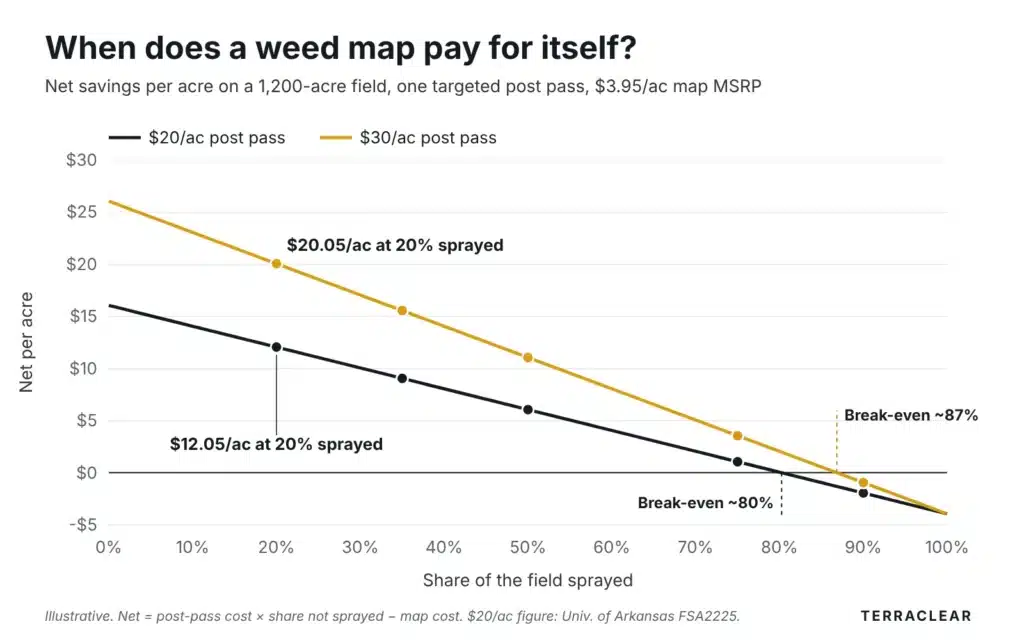
Take a 1,200-acre corn or soybean field with one targeted post pass and a TerraClear Weed Map at the $3.95 MSRP. With a $20 per acre post pass, the map pays for itself until about four of every five acres need spraying. When you spray one acre in five, you keep about $12 per acre.
The formula is simple: post-pass cost × share of the field you don’t spray – map cost per acre = net per acre. Application cost doesn’t change, because you still drive the whole field.
| Share of field sprayed | Net per acre, $20 post pass | Net per acre, $30 post pass |
|---|---|---|
| 20% | $12.05 | $20.05 |
| 35% | $9.05 | $15.55 |
| 50% | $6.05 | $11.05 |
| 75% | $1.05 | $3.55 |
| 90% | -$1.95 | -$0.95 |
Across all 1,200 acres with a $20 post pass, that’s $14,460 at 20% sprayed and $7,260 at 50% sprayed. At 90% sprayed, you’re out $2,340.
How we did the math
- Field: 1,200 acres, one targeted post-emergence pass, one TerraClear Weed Map for that pass.
- Map cost: $3.95 per acre mapped (MSRP), charged on every acre.
- Post-pass product: $20 per acre, the figure University of Arkansas used in its break-even analysis (FSA2225), and $30 per acre for a heavier program.
- Application cost: left out, because you still drive every acre whether you spray it or not.
- Residual: left out, because it stays broadcast.
- Not included: rescue passes, yield effects, or seasonal map pricing. Your chemistry, rates, and pricing will differ, so treat this as illustrative.
A few things to read out of that table:
- Weed pressure decides the answer. At 90% sprayed, no targeting method saves money. You’re paying to find weeds that are everywhere.
- Pricier post passes pay faster. At $30 per acre, break-even moves out to about 87% of the field sprayed.
- “Share sprayed” is not “share weedy.” A sprayer with section control turns on a whole section when one weed shows up in it. Nozzle control sprays tighter. A map works with either, but finer control means less of the field gets sprayed for the same weeds.
Kansas State ran the same kind of math on a 100-acre field with a drone map. Net savings after mapping ran from $1,860 when 10% of the field was weedy down to $29 at 90% weedy (K-State Agronomy eUpdate, 2026). Same shape, different crop.
Want this math run on your fields? Talk to a TerraClear rep and bring last year’s spray records.
When is targeted spraying not worth it?
Targeted spraying stops paying when you have to spray most of the field anyway. Heavy weed pressure, a weak pre-emergence program, a late flush after the map was made, and coarse sprayer control all push the sprayed share up. Escapes that go to seed cost you again next year.
Watch for these:
- Heavy pressure. Wisconsin data showed savings drop to about 2% on high-pressure soybean fields (UMN Extension, 2025).
- A thin residual. Fewer weeds at post time is what makes targeting work. See the Wisconsin numbers above.
- Timing. Weeds keep coming. A map describes the field on the day it was flown. That’s why a TerraClear Weed Map is delivered the next day on average, and why it picks up weeds as small as 1/4″, well under the 3″ to 4″ weed heights many post labels list.
- Escapes and the seedbank. A three-year Arkansas study found that at the least sensitive detection setting, weed density in targeted plots climbed from 867 to 11,300 plants per hectare (Weed Technology, 2025). A single waterhemp plant can produce about 250,000 seeds (Take Action, 2026). Cutting product only pays if control holds.
- Image resolution. A 2026 Montana State study found drone maps made at 4.2 to 13.2 mm per pixel missed many of the weeds a ground system caught (Frontiers in Agronomy, 2026). Resolution matters. TerraClear images whole fields at 1.5 mm, not samples.
Uncontrolled weeds can cut corn and soybean yields roughly in half, according to Weed Science Society of America estimates (Soltani et al., Weed Technology, 2017). The goal is the same control with less product, not less control.
How do I know if a weed map will pencil out on my farm?
Start with your post-pass cost and your best guess at weed pressure, then plug both into the Weed Savings Calculator. If your post pass runs $20 per acre or more and you expect to spray less than about two-thirds of the field, the math usually works.
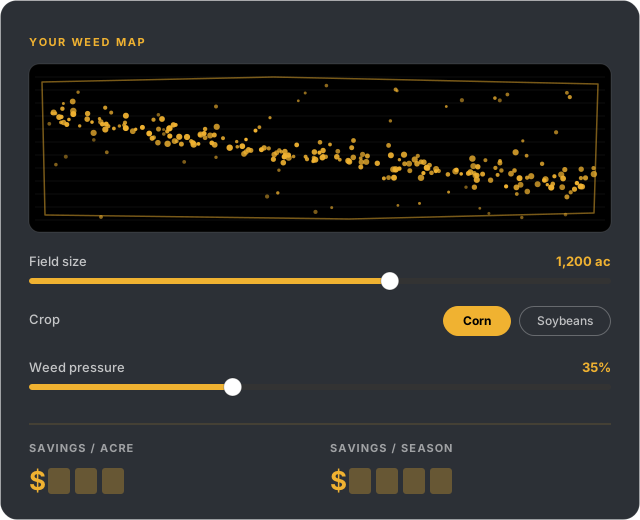
Four steps to run it:
- Pull your actual post-pass cost from last year’s invoice: product plus adjuvants, per acre.
- Estimate weed pressure honestly. Use your scouting notes or last year’s escapes. If you don’t know, run it at 20%, 35%, and 50%.
- Check your sprayer. Section control works. Nozzle control saves more. The precision plan integrates with most commonly used controllers and monitors, including John Deere, Ag Leader, and Case IH.
- Compare against the map cost. Use the current rate on the pricing page or in the app.
Want someone to check your numbers? Talk to a TerraClear rep. For background on how the map turns into a spray plan, read Weed Mapping 101 or see how TerraClear weed management works.
Frequently Asked Questions
About $94 per acre in Iowa for 2026, using Iowa State figures: $75 per acre of herbicide for herbicide-tolerant soybeans with two sprays, plus two custom passes at $9.35 each. NDSU budgets soybean herbicide at $46 per acre in southeast North Dakota.
Custom application runs about $8.50 to $11 per acre per pass in Iowa, Nebraska, and Kansas surveys for 2026, with tall-crop passes at the high end. Iowa State budgets corn herbicide at $56 per acre for 2026, so product is usually the bigger number.
TerraClear Weed Maps have an MSRP of $3.95 per acre mapped, with seasonal pricing incentives. Check terraclear.com/savenow or the TerraClear Mobile App for the current rate. Stand counts come with every Weed Map. For comparison, a 2026 Kansas State example modeled drone scouting at $2 per acre in labor.
If your sprayer already has section or nozzle control, a weed map is the lowest up-front cost, because there’s no hardware to buy. You pay per acre mapped. Camera retrofit kits run about $25,000 to $270,000, and a new camera sprayer about $750,000 or more, before any per-acre fees.
No. A TerraClear Weed Map works with the section control or nozzle control you already run. The precision plan integrates with most commonly used controllers and monitors, including John Deere, Ag Leader, and Case IH. Nozzle control sprays a smaller share of the field than section control.
University trials show post-pass savings from about 2% on heavy-pressure fields to about 90% on clean ones. Iowa State measured near 50% on a drone-mapped soybean field in 2024. TerraClear Weed Maps are built to cut herbicide use by up to 80% on the post pass.
No. Pre-emergence residuals still go on broadcast. Targeted spraying applies to the post-emergence pass. University of Wisconsin research found a strong residual makes the post pass easier to target and raises savings.
It can if weeds escape and go to seed. Arkansas research found weed density climbed over three years at the least sensitive detection setting. Detecting weeds small, spraying on time, and rotating modes of action keep control where it needs to be.
Sources
- Iowa State University Extension, Estimated Costs of Crop Production in Iowa 2026 (A1-20) and 2025 edition
- Iowa State University Extension, Iowa Farm Custom Rate Survey 2026 (A3-10)
- NDSU Extension, Projected 2026 Crop Budgets, Southeast North Dakota (EC1659)
- Purdue University, Indiana Herbicide Program Costs Through the Lens of Geography, 2026
- University of Nebraska-Lincoln, 2026 Nebraska Custom Rates
- Kansas State University, Kansas Custom Rates 2026
- University of Illinois farmdoc, Machinery Cost Estimates, 2025
- Iowa State University Extension, Drone-Based Weed Mapping for Targeted Spraying, Dec. 9, 2024
- Iowa State University Extension, Precision Spraying Technology, Aug. 22, 2024
- University of Arkansas, FSA2225, 2025; Avent et al., Weed Technology, 2024 and 2025
- University of Minnesota Extension, Targeted Spray Technology Highlighted, Jan. 21, 2025; Weed Management Updates for 2026, April 2026
- South Dakota State University Extension, EPA Approves Dicamba Over-the-Top Applications, March 2026
- University of Wisconsin, Badger Crop Network, Oct. 24, 2025
- Ugljic et al., Frontiers in Agronomy, 2025
- Barnhart et al., Weed Science, 2025
- Kansas State University Agronomy eUpdate, Issue 1109, June 25, 2026
- Sapkota et al., Scientific Reports, 2023
- Adhikari et al., Frontiers in Agronomy, 2026
- Sprayers101, The Economics of Spot Sprays, April 2026
- AgWeb, sprayer technology retrofit kits, March 2025
- Soltani et al., Weed Technology, 2017
- Take Action Waterhemp Factsheet, 2026
Connect with TerraClear

Don Scribner is Director of Product at TerraClear, where he leads development of TerraClear Rock Maps, Weed Maps and development of TerraScout. He has spent 19 years in agricultural manufacturing and technology, building products around what farmers actually need in the field. He is based in Grangeville, Idaho.