


Precision Agriculture and the Cognition Layer: The Future of Rock Mapping and Autonomous Scouting
In the rapidly evolving world of precision ag, the conversation is shifting from basic automation to deep machine intelligence. A recent discussion on the Truth About Ag podcast with Devon Lammers of TerraClear reveals how technologies like AI-driven rock mapping, autonomous field scouting, and high-resolution imagery are finally closing the gap between raw data and actionable return on investment (ROI).
For modern growers, the goal is no longer just “putting in time”—it’s about turning the farm into a “blackjack game” where you know the odds of every decision before the card is flipped.
Here’s a summary (TLDR) of this excellent interview:
1. The Missing Data Layer: From Satellites to Sub-Millimeter Resolution
While agriculture is swimming in data—ranging from satellite imagery to weather stations—much of it remains “low resolution.” To truly manage a crop at the plant level, standard 2-meter satellite resolution isn’t enough.
- The Resolution Gap: To identify a weed when it is only 1/4 inch large or to spot emerging weeds, pests, and disease, growers need millimeter-level resolution.
- The TerraScout Advantage: TerraClear’s autonomous field scout, TerraScout, is designed to capture four billion images per acre at one-millimeter resolution. This “missing data layer” allows for a hyper-resolution understanding of the field throughout the growing season.
- Edge Compute: Because of the massive data volume, this information cannot simply be uploaded to the cloud. It requires edge compute—processing the data on the machine or at the field edge—to turn images into “cognition” in real-time.
2. Revolutionizing Rock Mapping and Rock Picking
Rock picking has traditionally been the “job nobody signs up for.” It is labor-intensive, expensive, and inefficient. However, by applying AI and drone technology, rock picking is being “gamified” and optimized.
Efficiency Gains in the Field
- Reduced Costs: Traditional rock picking can cost over $25.00 per acre when factoring in wages, fuel, and equipment depreciation.
- Faster Turnaround: Using drone-based rock mapping, operations can finish clearing fields just days after seeding, rather than weeks.
- Predictive Maintenance: The hidden ROI of precision rock mapping lies in the fall. By removing rocks identified by AI, farmers significantly reduce downtime and repair costs for combines and headers during harvest.
“Knowing where all the rocks are—not just hoping people see them—removes the guesswork from the operation.”
3. Autonomous Field Scouting: Beyond the Rock
While rock mapping is the “low-hanging fruit,” the true potential of autonomous ground-based rigs like the TerraScout lies in full-season scouting.
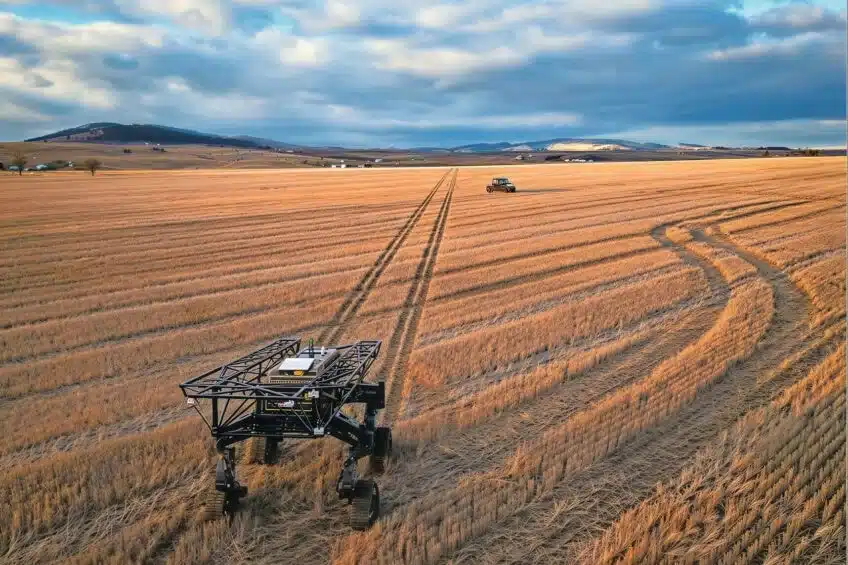
- Stand Counts & Germination: Instead of manual scouting at five spots in a field, AI-enabled cameras can calculate true germination and plants per square foot across the entire acreage.
- Precision Spraying: By identifying the exact maturity and species of weeds, the system can generate mission plans that tell the sprayer exactly when and where to apply product.
- Trial Validation: High-resolution scouting allows farmers to see the immediate impact of fertilizer trials (e.g., salt index effects) every 10 days, rather than waiting for harvest data in the fall.
4. Overcoming the “Manual Error” Hurdle
A major theme in the transition to precision ag is the removal of manual error. For AI and foundation models to work, the “garbage in, garbage out” rule applies.
| Action Item | Precision Ag Strategy |
| Data Integrity | Use a systematic, identical field-naming system across all software (JD Ops Center, TerraClear, etc.). |
| SOPs | Establish Standard Operating Procedures (SOPs) for data entry to prevent “nine different employees typing nine different names.” |
| Automation | Shift toward autonomous mission plans where instructions are sent directly to the machine monitor, bypassing manual input. |
5. The Future: Foundation Models and Blackjack Farming
The next frontier of agriculture is the shift from bespoke AI (identifying one specific thing like a rock) to Foundation Models—large-scale AI that draws correlations across the entire operation.
- Multimodal Data: Combining soil samples, yield maps, as-applied data, and high-res imagery into a single “cognition layer.”
- Predictive Analytics: Moving from “informative” (what happened) to “predictive” (what will happen).
- Natural Language Interaction: Future equipment will likely utilize Model Context Protocols (MCP), allowing farmers to talk to their machines rather than navigating complex menus on a screen.
Conclusion: The Path to Acre-by-Acre Profitability
The ultimate goal of integrating agriculture drones, rock mapping, and autonomous scouts is to achieve acre-by-acre profitability. By knowing the exact ROI of every input on every parcel of land, the farm becomes a self-managed business driven by data rather than gut feel.
As the industry moves toward 2026 and beyond, the winners will be those who embrace the “Simple Button”—technologies that collaborate across platforms (like John Deere and TerraClear) to make the producer’s life easier, not more complicated.