


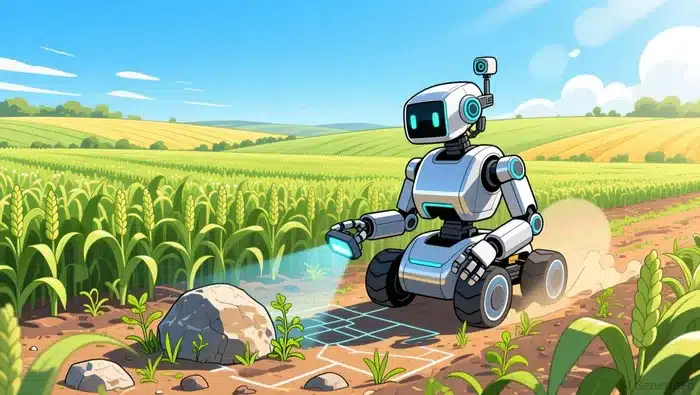
TerraClear’s launch of the TerraScout robot marked a clear step on the automation S-curve, moving from data collection to autonomous scouting. The machine’s ability to map over 1,000 acres per day and convert that data into actionable plans is impressive. Yet, the company’s platform still operates in a critical gap: it excels at perception and planning but relies on existing, often human-operated, equipment to execute tasks. The appointment of Eric Rombokas as Director of Robotics and Hardware is a direct move to bridge that chasm.
Rombokas’s expertise is precisely in the domain where most field robotics fail. His work at the University of Washington focuses on controlling robots in unstructured environments, a challenge that mirrors the unpredictable nature of a farm field. His research on brain-controlled movement and tendon-driven robotic hands for prosthetics tackles the core problem of dexterous manipulation and real-time adaptation-skills needed for a robot to not just navigate around a rock, but to pick it up and place it correctly. This is the leap from perception to physical action.
For TerraClear, this hire is about building the hardware rails for true autonomy. The company has the software stack for identifying rocks and weeds. Now it needs the mechanical and control systems to act on that intelligence. Rombokas’s background in merging control theory with real-world data offers a path to create robots that can handle the variable terrain, weather, and debris of a field with the reliability required for commercial farming. This isn’t just about adding another robot; it’s about creating the physical layer that can execute the precise, high-resolution plans TerraScout generates.
The strategic implication is clear. By strengthening its hardware and robotics team, TerraClear is positioning itself not just as a data provider, but as a full-stack automation platform. It’s moving from being the scout to becoming the executor, which is where the most valuable and defensible part of the agricultural automation stack lies. This hire directly addresses the adoption rate bottleneck: making autonomous action technically feasible and economically viable for growers.
The Exponential Playbook: From Data to Integrated Action
TerraClear’s growth trajectory is a classic example of moving up the technological S-curve. The company started with a focused, high-ROI problem: mapping rocks to protect expensive farm machinery. That initial hardware and AI stack has now evolved into a full data collection platform with the TerraScout robot. The early traction is solid, with the system already mapping nearly 1 million acres across 1,000 farm operations. This isn’t just incremental; it’s building the foundational data layer for a much larger paradigm shift.
The market context shows why this timing is critical. The North America precision agriculture market is projected to grow at a CAGR of 9.97% through 2033, driven by the need for more efficient, sustainable food production. TerraClear is positioned to capture a significant share of this expansion by solving the adoption bottleneck: translating data into physical action. Its current focus on rock and weed management is a smart, high-impact entry point. These are costly, labor-intensive problems that directly improve ROI for farmers, making the technology’s value proposition clear and compelling.
The company’s playbook is now clear. It leverages its autonomous scout to gather ultra-high-resolution data at scale, then uses that intelligence to drive action through existing equipment. This hybrid model lowers the barrier to entry for farmers while building a proprietary data moat. The strategic hire of a robotics expert signals the next phase: moving from directing existing machinery to building the hardware rails for integrated, autonomous execution. The exponential growth potential lies in this transition-from a data provider to a full-stack automation platform. As the market expands, TerraClear’s ability to offer an end-to-end solution, from perception to physical action, will determine its position at the crest of the adoption wave.
Building the Infrastructure Layer: Competitive Context and Integration
The trend toward integrated hardware-software stacks is reshaping the agricultural technology landscape. Major equipment manufacturers like John DeereDE-0.11%, AGCO, and CNH IndustrialCNH+0.75% are expanding through these very ecosystems, creating closed loops that lock in data and services. This shift defines competition not by standalone products, but by the depth of the entire digital farm platform. For a new entrant like TerraClear, this creates a clear strategic choice: build a competing tractor, or become the essential infrastructure layer that any tractor-new or old-needs to be truly smart.
TerraClear’s model is a masterclass in bypassing the capital-intensive hardware race. Instead of manufacturing its own tractors, the company focuses on the data and intelligence layer. Its TerraScout robot acts as a high-resolution scout, gathering the critical input. The key innovation is converting that raw data into what the company calls “mission plans” for existing farm equipment. This approach is a direct response to a major adoption friction: the vast diversity of tractors, implements, and control systems already on the ground. Integrating with this patchwork of legacy and modern machinery is the central risk. A solution that works only with a single OEM’s equipment would have a tiny, non-scalable market.
By delivering actionable plans, TerraClear sidesteps this integration nightmare. It doesn’t need to speak the proprietary language of every manufacturer; it simply provides the precise instructions for where to go and what to do. This positions the company as a neutral, high-value layer in the automation stack. Its competitive moat is built on the quality and scale of its data-mapping nearly 1 million acres across 1,000 farm operations-and the intelligence to turn it into executable tasks. The market itself supports this model, with the global precision agriculture sector projected to grow at a CAGR of 10.50% through 2031, driven by the very need for such integrated, efficient solutions.
The bottom line is that TerraClear is building the rails for a new paradigm. It’s not competing with the OEMs for the tractor seat; it’s competing for the data center. Its strategy of converting perception into mission plans for existing equipment is a pragmatic, exponential play. It leverages the installed base of farm machinery while building a proprietary data moat. In a market where ecosystem depth is the new battleground, TerraClear’s model offers a faster, cheaper path to scale by becoming the indispensable intelligence layer that any farm, regardless of its equipment brand, must use.
Click here to read the remainder of the article