


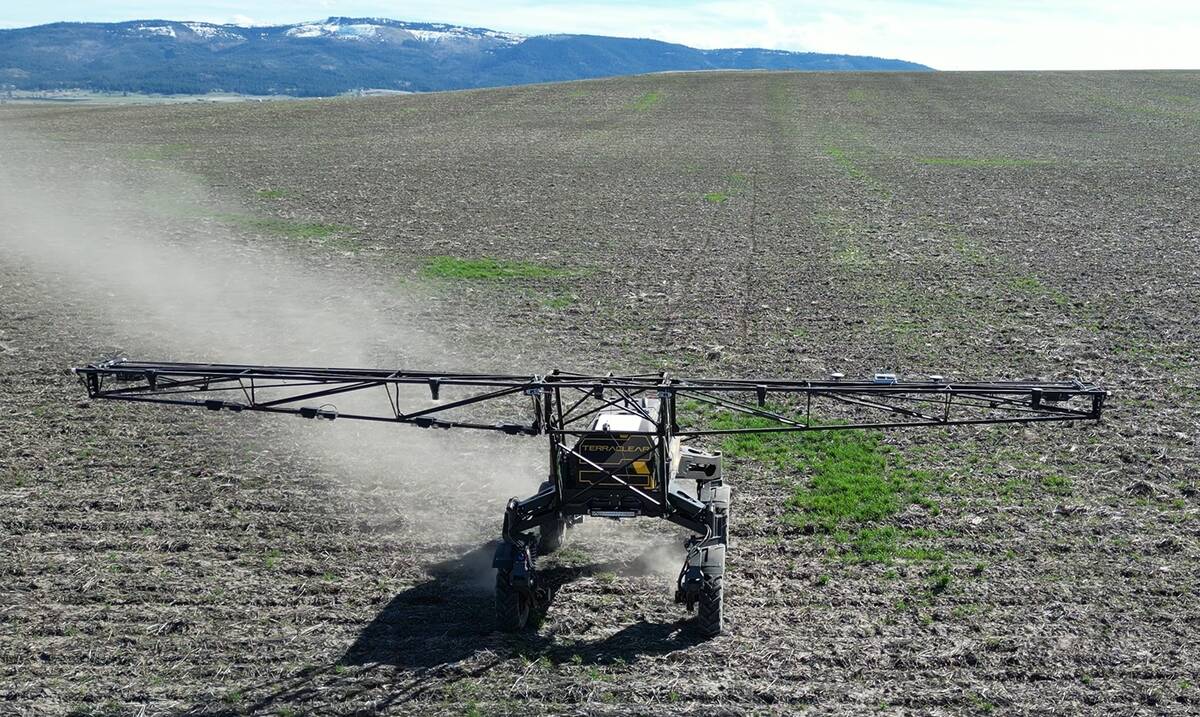
TerraScout robot scans fields for weeds and rocks while developing plans farmers can use to fight them
An autonomous mobile robot is coming to ag equipment dealerships in Canada in 2027. The company says it’s targeted toward Western Canadian crops and the farmers who grow them.
The TerraScout Autonomous Robot, which has already been launched in the United States by ag tech company TerraClear, is an artificial intelligence- and GPS-powered platform that can scout a whole field for weeds and rocks using “ultra high-resolution” imagery.
It then converts that data into field prescriptions that can be used by the farmer to, among other operations, develop a spraying plan of action.
Why It Matters
With precision farming continuing to become a strategic choice for producers, robotics may be the next step in that transition.
TerraClear chief executive officer Devin Lammers says the machine is a fit for wheat, canola and other crops common to Western Canada.
He believes the tool is going to be a game changer for farm management overall. One example is its ability to gather field data at a micro-level never seen before in a broad acre crop context.
“We’re one of the few people, I think, developing large-scale robotics in the commodity row crops or broad acre crops or small grains.”
Lammers says the robot is intended to “live in the field” all season long and help growers understand what’s going on at the plant level and what they can do about it.
“The beauty of where AI is going, with increasingly voluminous data and foundation models, it’s like we can start to draw these inferences of in-season crop conditions and performance that we may not even know exist today.”
Next level precision
The robot’s imaging capabilities work at an extremely high resolution of 1 mm ground sampling distance (GSD), while collecting four billion image samples per acre.
Essentially, the larger the value of a GSD, the lower the spatial resolution of the image. And because the bot’s GSD is extremely small, it enables the ultra high-resolution touted by TerraClear.
Beyond that, the company says the eight-foot-wide TerraScout can:
Map more than 1,000 acres per day at speeds of up to 15 m.p.h. (24 km/h) with a 60-foot mapping swath.
Operate fully autonomously for up to six hours before refueling.
Run 24 hours per day, seven days per week in most weather conditions.
Detect rocks eight inches and larger and calculate an optimal picking path.
Analyze fields on a one-sq.-ft. grid to determine weed pressure. Current models identify weed density, but TerraClear intends in future models to expand into weed species and maturity identification.
Assess stands for plant counts and emergence quality.
The unit captures so many high-res images, even the cloud can’t handle it all, says Lammers. Instead, the images are sent to an onboard computer (known in tech circles as “edge computing”), while at the same time offering a side benefit to producers concerned about the security of their farm data.
“It’s really important for what we do because the data sets we deal with are so large we can’t just beam them to the cloud for processing,” he says.
“We are collecting roughly one millimetre resolution imagery across the field, and that’s across thousands of acres, and so that ends up being many gigabytes, if not terabytes, of data.”
The robot can run on all but extremely wet soils, but there are signs it may be able to traverse even those conditions, says Lammers.
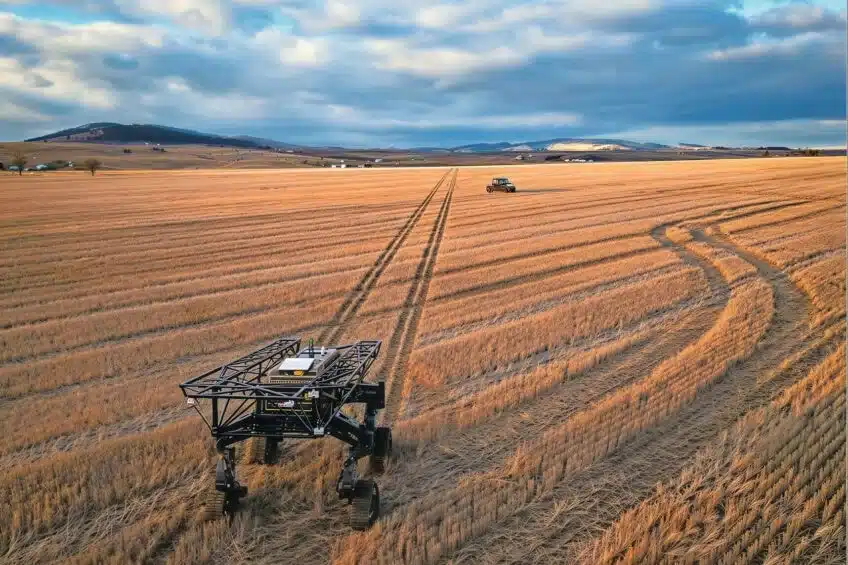
“We have a unit running right now mapping wheat fields in Idaho, and about a week ago we got two inches of rain, and we’re like, well, let’s throw it in the field, see how it does. We have versions with both tires and tracks. We threw the track version in there and it did just fine.”
However, operating in extremely wet soil conditions is more of an example of the machine’s flexibility than a recommended practice.
“You’re not going to put a sprayer in the field when your farm is wet, and so it doesn’t really make sense to collect the map or imagery at that point anyway.”
He says producers he talks to are simultaneously excited and skeptical when presented with the TerraScout Autonomous Robot, but Lammers considers this a good thing.
“I think farmers tend to be incredibly innovative, and they’re constantly looking for whatever the latest technology is, but they’re also, I think, naturally skeptical around (whether it) will it work for my operation. I think that that’s a healthy skepticism.”
Read the full article here